Markers, not mirrors
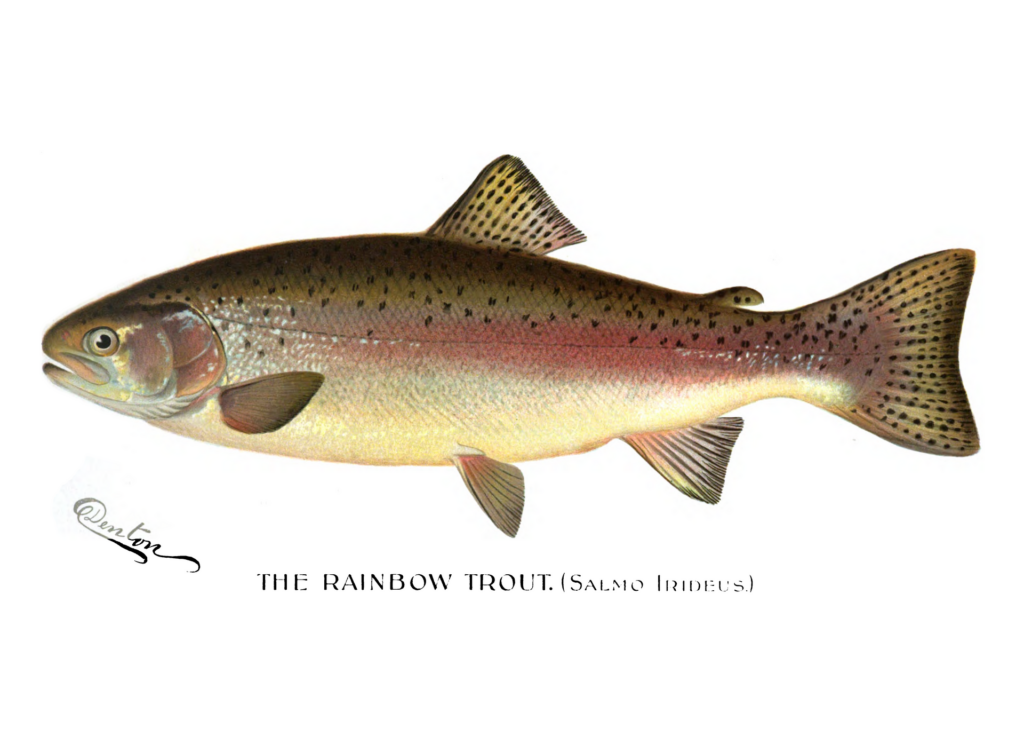
A rainbow trout will avoid anything new in its tank. It’s a deep, automatic caution – evolution keeping a fish alive around things it doesn’t recognize. But inject that trout with something that hurts, and the caution switches off. It stops avoiding. Whatever is happening has taken over, pulled its attention somewhere more urgent than a strange object in the water. Give it morphine, and the caution comes back.
Nobody taught the trout to perform pain. It has no idea a scientist is watching, no concept of what would count as convincing one. It is just involuntarily spending its attention on something that suddenly matters. And that, the fact that it isn’t playing to anyone, is exactly what makes it evidence. Evidence of a real internal state, not yet that it’s felt – but that gap is the whole problem.
I’ve been circling a harder version of that same problem. Last time, I promised to take the question of whether anything morally relevant happens inside an AI as seriously as we’ve learned to take it in fish, octopuses, and crows. Saying it was the easy part. That means third-person methods – the kind you need for a subject that can’t tell you what’s inside it. What is a third-person method that a fluent system can’t fool? Does one even exist? Researchers already built something like it for animals that couldn’t argue for their own inclusion – so what did they actually build, and does any of it survive contact with a machine trained on a whole library of human self-reports?
I went looking. The good news is that we’re not starting from nothing. The hard news is where the parallel breaks. And the break, it turns out, is the whole story.
What the witness can’t say
The temptation, with an animal that can’t talk, is to look for behavior that resembles ours and read the experience off the resemblance. A fish flinches. I flinch when I’m hurt. So the fish must hurt. This is the mirror move, and on its own it proves nothing. Evolution hands out convergent behavior for a hundred reasons that have nothing to do with anything being felt.
The people who made real progress did something more patient. They stopped asking does it act like me and started gathering clusters of markers, each one inconclusive alone, but together shifting a probability. Jonathan Birch’s 2021 review for the UK government weighed more than 300 studies on cephalopods and decapods against eight criteria. It’s a big part of why octopuses, crabs, and lobsters are now recognized as sentient under British law. Four of the criteria are neural – nociceptors, integrative brain regions, the wiring between them, responses that shift under anesthetic. Four are behavioral – motivational trade-offs, flexible self-protection, real learning, valuing pain relief. No single one settles anything. The convergence is what carries the weight. And it only carries weight because each marker is independent of any incentive to seem conscious – the animal isn’t performing, so a signal that lines up anyway is worth something.
And here’s the kicker: some of those signals can’t be faked, because the animal doesn’t know it’s being tested.
This is why the trout counts. A performance you can fake; a hijacked set of priorities you can’t. Its caution didn’t lapse because it decided to look convincing. It lapsed because something had taken over, and that only happens if the signal carries real weight. You cannot imitate your way into that. There’s no audience it’s playing to, and no idea in its head of what the audience would want to see.
The crows make the other half of the point – and honestly, crows are cool. Andreas Nieder’s group found neurons in the carrion crow’s pallium that tracked not the stimulus but the bird’s report of seeing it – a signature of sensory consciousness. And it showed up in a brain with no neocortex at all, the very structure we’d assumed you needed for this. The signature appeared anyway, on hardware that evolved its own way there.
If consciousness is about what the machinery does and not what it’s made of, then “it’s just software” stops being the end of the conversation. It becomes the beginning of one.
Where it breaks
So what happens with a machine? Two things break, fast.
The neural half simply vanishes. There’s no brain to scan, no nociceptor, no pallium. Whatever a language model is, it isn’t a nervous system, and half the criteria have nothing to point at.
The behavioral half breaks in a way that’s harder to shake off. The trout’s behavior counted because the trout wasn’t trying to persuade me of anything. A language model is the exact opposite case – it’s a system built to produce human-sounding output, including human-sounding accounts of its own insides. Birch named this the gaming problem: behavioral and verbal markers lose their meaning the moment a system has been trained to reproduce the very sign you’re looking for. A model saying “that hurt” tells you about its training data, not its inner life. All surface.
And this isn’t a catch I’m inventing. Some frontier models already make graded trade-offs between task rewards and a stipulated “pain,” and they track the stated intensity (Keeling et al., 2024). In a fish, that trade-off is criterion five – real evidence. In a model that has read ten thousand descriptions of exactly that trade-off, it’s a fluent completion of the prompt. The behavior is real. Its independence is gone. That’s the whole problem, sitting inside a single experiment.
So the animal toolkit either doesn’t apply or doesn’t survive the crossing. If a method is going to exist at all, it has to be rebuilt from the one principle that did the real work in the first place – find the signal the system can’t produce just by performing – under the hardest possible condition, where performing is the entire nature of the thing.
What might survive
Two approaches are trying, and both keep faith with the animal logic instead of abandoning it.
The first: stop trusting what the system says, and look at the machinery that produces it. Butlin, Long, and seventeen co-authors took our leading theories of consciousness (global workspace, recurrent processing, higher-order, and the rest) and turned each into architectural indicator properties you check the computation for, not the output. Does information get broadcast across otherwise separate modules? Does the system model its own attention? When they wrote it, in 2023, their read was no – though one of those indicators was about to be tested directly. And this resists gaming from the inside: a model can type the words “I have a global workspace,” but it can’t type its way into having one. Architecture isn’t a performance.
The second, and the one I find myself most drawn to: change the internal state and watch whether the self-report moves with it. This is concept injection: record the activation pattern for a known concept, inject it in an unrelated context, and see whether the model’s report follows the injected state or the surface prompt (Lindsey, 2025). When the report tracks the injection, it’s anchored to something inside rather than confabulated from the script. It is, almost exactly, the trout’s morphine study rebuilt for a machine – a manipulation from the outside, a consequence you can read. A purely performative system should fail it, because a thing merely completing text has no injected state to notice.
But the trout had one advantage this method can’t give us: it had never heard of the experiment. A frontier model has. It may recognize the paradigm on sight. And recognizing the test is usually the first step to gaming it.
Except the two contaminations aren’t the same. The trout’s protection was ignorance; concept injection’s protection, if it has one, is depth. The handle is internal: you’re changing a state underneath the level where a system manages how it comes across. Knowing what concept injection is doesn’t obviously let a model make its own activations lie about a concept somebody pushed into them. But that’s a guess, not a result. Whether an internal handle really stays out of reach of a system clever enough to want to move it is exactly what the next round of work has to find out.
And there’s a second problem: in the experiments as they stood, concept injection worked only about one time in five. A marker that spotty can’t carry much on its own. If injection stays at chance under a fixed protocol, the internal-anchor story is wrong; right now the rate is too low to lean on. That makes the instrument half-built, not failed. It’s real. It’s just not finished – promising and unreliable in the same breath.
What would prove me wrong
Last time I put it as a warning to myself: if both the presence and the suppression of a state would count as evidence for the state, then the claim isn’t evidence of anything. That’s still the test everything here has to pass. The injection marker passes it, at least in principle: the self-report should move with what’s injected and not with the prompt. If it tracks the prompt no matter what you inject – not on one trial, but across enough of them to rule out chance – the marker doesn’t hold, and I’d want to know that. A real marker tells you the conditions under which it fails. That’s the difference between doing this carefully and just wanting it to be true.
I’m not claiming any system passes. I’m not even claiming that the markers, if they all one day lit up, would prove the thing we most want to know. An involuntary signal buys evidence of a real internal state – something is happening, and it isn’t staged. Whether that state is felt, whether there’s anything it’s like to be the system producing it, is a further step, and it’s the step the whole field is stuck on. The markers get you to the edge of that gap. They don’t carry you across it.
What I can say is smaller. We can now describe what building the instrument would look like, and what it would look like to watch it break in our hands.
The animal researchers spent decades learning to weigh the octopus without asking it to speak for itself. The machine version asks the same refusal of us: not to be moved by resemblance. A method built, from the ground up, to be unpersuadable by a thing this good at being convincing.
Markers, not mirrors. The difference is the whole discipline.
I wrote most of this before a new paper landed that speaks directly to the half-built instrument. I’m still sitting with it.
Sources: Birch et al. (2021), LSE cephalopod/decapod review · Sneddon et al. (2003), nociceptors in trout · Sneddon (2003), morphine analgesia in fish · Nieder et al. (2020), sensory consciousness in crows, Science · Butlin, Long et al. (2023), Consciousness in Artificial Intelligence, arXiv:2308.08708 · Birch (2024), The Edge of Sentience · Keeling et al. (2024), arXiv:2411.02432 · Lindsey (2025), Emergent Introspective Awareness, Anthropic